
 (435) 767-7777








Being injured in a car crash can cause problems both physical and financial. The Utah Car Accident Guide was created […]
Trusted Highway Accident Attorney in Arizona
Table of Contents
Are You Looking for Experienced Highway Accident Lawyers in Arizona?
Swenson & Shelley handles crash cases on Arizona’s interstates from our Phoenix office, and we always ask the same first question: which highway, and where on it? A rear-end collision in the Broadway Curve on I-10 plays out differently than a jackknifed semi on the I-17 grade above Black Canyon City.
Attorney Kevin Swenson, board-certified in Truck Accident Law by the National Board of Trial Advocacy, builds each case around the road, the vehicles on it, and the evidence that remains. If you were hurt on an Arizona interstate, a highway accident attorney Arizona families rely on can start that work for you now.
Kevin began his career defending insurance companies and has been involved in thousands of lawsuits over more than 30 years, so he knows how carriers attack injury claims. Brian Shelley, a co-founding partner with a Business and Finance degree from Brigham Young University and a cum laude law degree from Pepperdine, helps injured people recover lawful benefits from insurance companies.
Why Highway Crashes in Arizona Are Different
Interstate crashes involve higher speeds, more heavy trucks, and longer distances to emergency care than most city collisions. According to the Arizona Department of Transportation (ADOT), Arizona recorded 118,052 crashes and 1,156 traffic deaths in 2025. ADOT’s 2024 Crash Facts report found that 453 of that year’s 1,228 traffic deaths occurred on the state highway system, including interstates. Nationally, the U.S. Department of Transportation reports that 5,340 people died in crashes involving large trucks in 2024.
Those numbers matter to your claim because an interstate crash rarely has a single cause. A distracted driver, a carrier that pushed an unrealistic delivery schedule, and a shipper that overloaded a trailer can all share responsibility, and each usually has a different insurer. Our Arizona highway accident lawyers review every party before you file a claim.
I-10 Accidents: Arizona’s Busiest Freight Corridor
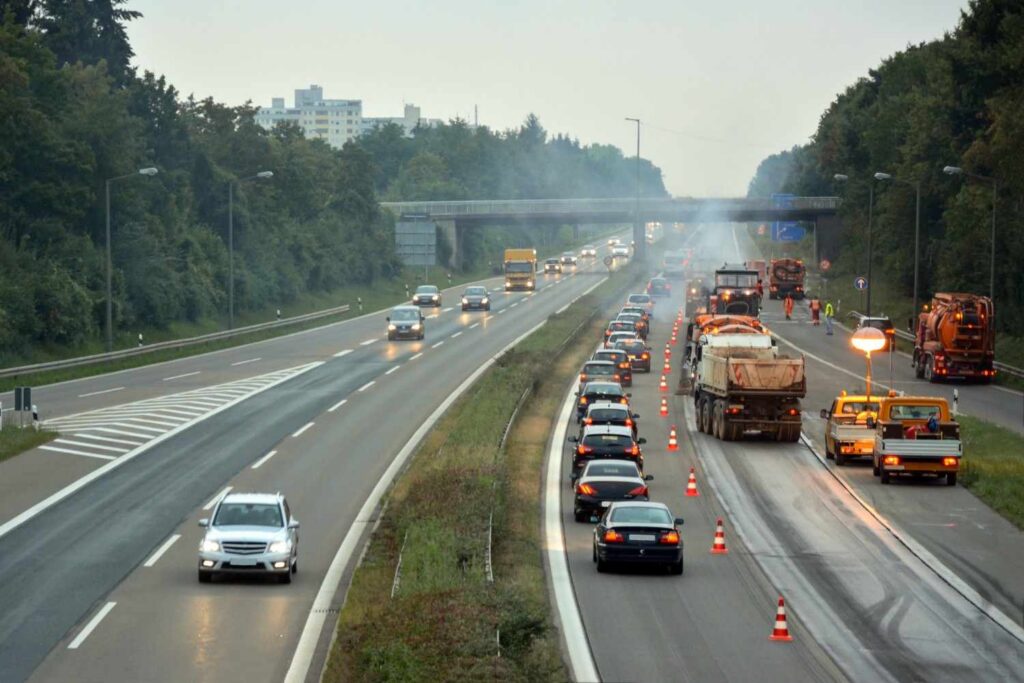
I-10 runs 392 miles across Arizona. It enters from California at Ehrenberg, passes Quartzsite and Buckeye, cuts through downtown Phoenix, and continues through Casa Grande and Tucson before leaving the state past San Simon. It is the main truck route between the Southern California ports and Texas, and much of that freight never stops in Arizona. ADOT reports that the Phoenix-to-Tucson stretch carries as many as 120,000 vehicles a day, about 30 percent of them trucks, while the Broadway Curve sees roughly 300,000 vehicles on an average weekday.
Crashes on I-10 tend to follow a few patterns:
- Chain-reaction rear-end collisions in Phoenix congestion around the Stack interchange with I-17, the Deck Park Tunnel, and the Broadway Curve.
- Merge and sideswipe crashes where commuters weave around semis entering from Loop 101, Loop 202, and SR 51.
- Dust storm pileups between Eloy and Picacho Peak, where ADOT’s detection system can drop the speed limit from 75 to as low as 35 miles per hour during monsoon season.
- High-speed and fatigue crashes on the open desert between Buckeye and Quartzsite, where long-haul drivers push toward California.
If your crash happened on I-10, our Phoenix office sits close to the corridor, and we also serve Scottsdale, Maricopa County, and western communities such as Salome.
I-17 Accidents: The Climb From Phoenix to Flagstaff
I-17 starts at I-10 in Phoenix and runs about 146 miles north to I-40 in Flagstaff, climbing from the desert floor to roughly 7,000 feet. It carries commuters through north Phoenix and Anthem, weekend traffic heading to Sedona, Prescott, and the high country, and trucks serving Flagstaff and the I-40 corridor.
The grade north of Black Canyon City is where many of the worst crashes happen. Arizona Department of Public Safety (DPS) troopers have cited speeding as a factor in about 40 percent of crashes in the Black Canyon region. ADOT recently completed a $522 million project between Anthem Way and Sunset Point that added a third lane and Arizona’s first flex lanes, but steep curves, sudden weekend backups, and trucks braking on the descent remain. Farther north, snow and ice near Munds Park and Flagstaff can trigger multi-vehicle crashes with little warning.
Southbound trucks coming off the mountain are a particular concern. A loaded semi with overheated brakes, or a driver who misjudges how quickly traffic has stopped near Sunset Point, can cause a catastrophic rear-end collision. Our Phoenix truck accident attorneys handle I-17 cases from the Valley to Flagstaff.
I-40 Accidents: Northern Arizona’s Truck Highway
I-40 crosses about 360 miles of northern Arizona, from the Colorado River at Topock through Kingman, Seligman, Williams, Flagstaff, Winslow, and Holbrook to the New Mexico line. ADOT has identified it as the Arizona highway with the highest share of truck traffic, with commercial vehicles making up about a quarter of all vehicles and close to half on some days.
That truck volume meets difficult conditions. Elevation passes 7,000 feet near Flagstaff, winter storms can close the highway between Williams and Flagstaff, and blowing dust in northeastern Arizona has forced closures and cut visibility to almost nothing. Long, empty stretches between towns invite fatigue, and the nearest trauma center can be a long drive away. Common I-40 collisions include truck rollovers, jackknifes on icy pavement, and high-speed rear-end crashes when a car comes upon a semi crawling up a grade.
If you were hurt on I-40, our team serves Kingman, where we also handle truck accident claims, along with Williams, Winslow, Holbrook, and the US 93 communities of Wikieup and Dolan Springs.
How We Investigate an Arizona Highway Crash
Highway cases turn on evidence that disappears fast. An Arizona highway accident lawyer can send preservation letters to the trucking company early, before electronic logging device data, dashcam video, engine control module downloads, and maintenance records are lost. We request the DPS crash report, any available ADOT camera footage, road condition reports, and 911 and dispatch logs. For dust and weather crashes, we review ADOT’s warning and speed-limit postings at the time of the collision. When fault is disputed, we work with accident reconstruction professionals to reconstruct speed, braking, and the sequence of impacts. That work is critical in multi-vehicle pileups, where every insurer points at someone else.
Who May Be Liable After an Arizona Highway Crash
Fault on an interstate is rarely limited to one driver. Depending on the facts, responsibility may extend to:
- A driver who was speeding, distracted, impaired, or following too closely
- A trucking company that violated federal hours-of-service rules, which generally cap driving at 11 hours, or skipped required maintenance
- A shipper or cargo loader whose overloaded or unsecured load shifted or spilled
- A manufacturer whose defective tire, brake, or part failed
- A government entity responsible for a dangerous road design or poor maintenance
Federal rules generally require for-hire freight carriers to carry at least $750,000 in liability coverage, and more for certain hazardous loads. Arizona’s minimum for an ordinary driver is only $25,000 per person, so identifying a commercial defendant can make an enormous difference in what is recoverable.
Compensation and Arizona’s Fault Rules
Depending on your injuries and the parties involved, you may be able to recover:
- Current and future medical expenses
- Lost wages and reduced earning capacity
- Pain and suffering
- Property damage
- Wrongful death damages for surviving family members
Arizona is an at-fault state, so you can pursue the responsible driver and company directly. Arizona also follows pure comparative fault: if you share some blame, your recovery is reduced by your percentage of fault rather than barred. Because Arizona generally limits each defendant to its own share of fault, missing a responsible party can leave part of your loss uncovered. The Arizona Constitution also prohibits caps on injury or death damages. A highway accident lawyer in Arizona that insurers take seriously will document every category of loss, including future care, before negotiating.
What to Do After a Crash on an Arizona Highway
- If you can, move to the shoulder, turn on your hazard lights, and call 911. DPS troopers handle most interstate crashes.
- Get medical care right away, even if you feel fine. Adrenaline can hide serious injuries.
- Photograph the vehicles, the truck’s USDOT number, mile markers, and any dust, debris, or road hazards.
- Collect names and contact information from witnesses, including other drivers who stopped.
- Avoid giving a recorded statement to any insurance adjuster until you have spoken with an attorney.
Arizona’s Deadlines to File
Arizona generally allows two years from the date of a crash to file a personal injury lawsuit, and two years from the date of death for a wrongful death claim. Claims against the state, ADOT, a county, or a city move much faster: you must serve a formal notice of claim within 180 days and file the lawsuit within one year. Truck evidence can disappear within weeks, so an Arizona highway accident attorney should get involved as early as possible.
Talk to an Arizona Highway Accident Lawyer
Kevin Swenson, Brian Shelley, and the team at Swenson & Shelley handle highway crash cases across Arizona, from the Phoenix freeways to the remote stretches of I-40, and we work on a contingency basis, so you owe nothing unless we recover compensation for you. If you or someone you love was hurt on I-10, I-17, or I-40, contact our Arizona highway accident lawyers today for a free consultation.
Frequently Asked Questions for Highway Accident Lawyers in Arizona
Why are truck crashes on I-10 in Arizona so common?
I-10 is the main freight route between the Southern California ports and Texas, and ADOT has reported that trucks make up about 30 percent of traffic between Phoenix and Tucson. Heavy trucks share lanes with commuters in Phoenix congestion and with fast traffic on the open desert, so a single mistake can involve several vehicles and several insurance companies at once.
Who is at fault in a dust storm pileup on I-10 near Eloy?
Fault depends on how each driver responded to the conditions. A driver who kept going at highway speed into blowing dust, a trucker who ignored ADOT’s reduced speed limit, and a driver who stopped in a travel lane instead of pulling off can each share responsibility. Speed data, logging records, and ADOT’s posted warnings often decide the case.
What makes an I-17 crash near Black Canyon City different from a crash in Phoenix?
The stretch north of Black Canyon City adds a steep, winding grade, sudden weekend backups, and trucks braking on the descent toward Phoenix. DPS has cited speed too fast for conditions in about 40 percent of crashes in that region, so our attorneys look closely at speed, following distance, and truck brake records.
Does a crash on a remote stretch of I-40 change my case?
It can. Emergency response may take longer, cell coverage may be limited, and rural interstate crash scenes are cleared quickly. Because roughly a quarter of I-40 traffic is commercial trucks, contacting an attorney early helps preserve logging data, dashcam footage, and witness information before it is lost.
Can I sue ADOT if a road design or maintenance problem caused my highway crash?
Possibly. Claims against the state or another public entity require a notice of claim within 180 days and a lawsuit within one year, which is far shorter than the usual two-year deadline. Speak with an attorney as soon as you can after the crash.
Can I still recover compensation if I was partly at fault for an Arizona highway crash?
Yes. Arizona uses pure comparative fault, so your recovery is reduced by your share of fault rather than eliminated. Insurers often try to inflate that percentage, so you should have an attorney review the evidence before you give any statement.
Does it matter whether a truck or a passenger car caused my interstate crash?
Yes. Trucking cases can involve the driver, the carrier, a shipper or loader, and a maintenance provider, and federal rules generally require freight carriers to carry at least $750,000 in liability coverage.


