 (435) 767-7777
Experienced 18-Wheeler Accident Attorney in Salt Lake City, UT
 In Need of a Trusted 18-Wheeler Accident Attorney in Salt Lake City
Interstate 15 cuts straight through the middle of Salt Lake City, and Interstate 80 crosses it heading east into Parleys Canyon and west across the salt flats. Add Interstate 215 looping around the valley and the freight yards near the Union Pacific rail hub, and you have one of the busiest 18-wheeler corridors in the Intermountain West. Thousands of tractor-trailers move through the valley every day, and when one of them collides with a passenger vehicle, the results are rarely minor. If you or someone you love has been hurt in a crash like this, an 18-wheeler accident attorney in Salt Lake City from Swenson Shelley Law can help you understand what actually happened and what you are owed.
Why These Crashes Happen on Salt Lake City Roads
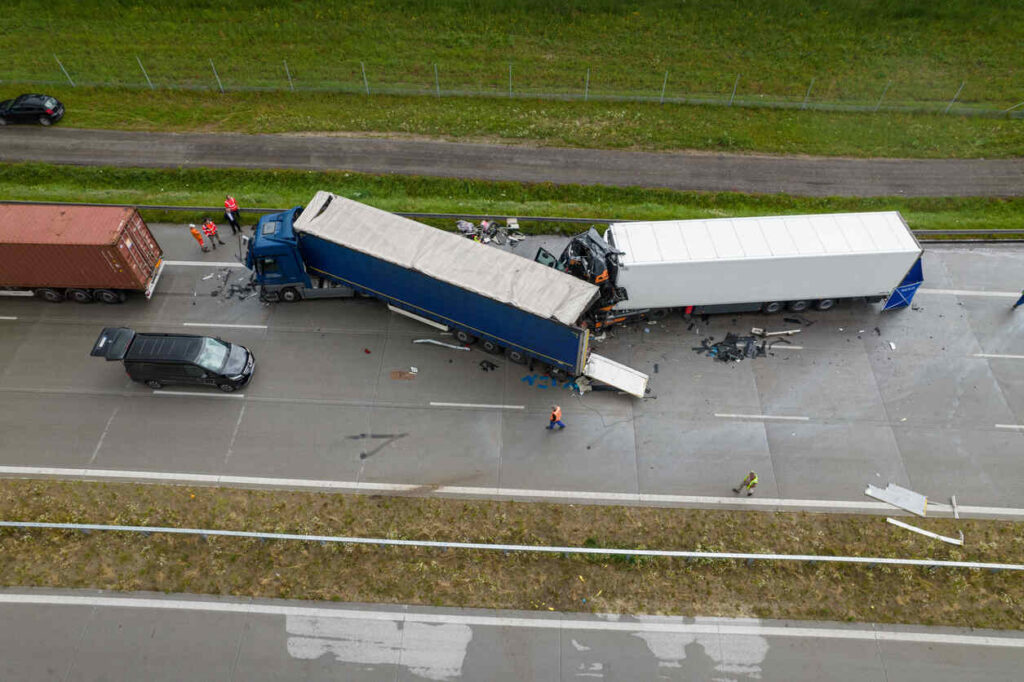
An 18-wheeler weighs up to twenty times more than the average sedan, so a collision rarely ends like a two-car fender bender. Around Salt Lake City, a few local factors show up again and again: winter storms rolling off the Wasatch Front that turn I-15 and I-80 into ice sheets within minutes, the steep grade and tight curves through Parleys Canyon that punish drivers who misjudge their speed, and heavy freight traffic funneling through the valley’s warehouses and distribution centers at all hours.
Behind those road conditions sit the more common causes investigators look for: a driver pushed past a safe number of hours behind the wheel, a truck that was not maintained on schedule, cargo that was loaded incorrectly and shifted mid-transit, or a trucking company that pressured a driver to make a delivery window it never should have promised. Sorting out which of these applied in your crash is exactly the kind of work a Salt Lake City 18-wheeler accident attorney takes on early, before evidence disappears.
The Federal Rule Most Salt Lake City Drivers Have Never Heard Of
Commercial truck drivers can’t decide for themselves how long to stay on the road. Federal Motor Carrier Safety Administration regulations limit a driver to 11 hours of driving within a 14-hour window, only after the driver has taken 10 consecutive hours off duty. A 30-minute break is required after 8 hours of driving, and weekly limits cap total driving at 60 hours over 7 days or 70 hours over 8 days for most carriers. In short, the core limits every driver hauling freight through the valley must follow are:
- 11-hour driving limit: up to 11 hours of driving after 10 consecutive hours off duty
- 14-hour on-duty window: all driving must happen within 14 hours of coming on duty, with no pause for loading, fueling, or paperwork
- 30-minute break: required once a driver has logged 8 cumulative hours behind the wheel
- 60/70-hour weekly cap: no more than 60 hours on duty over 7 days, or 70 hours over 8 days, for most carriers
These rules exist because fatigue behind an 18-wheeler is not minor. A driver awake and working for 13 hours reacts to a sudden stop on I-15 the same way a driver reacts after several drinks. When a trucking company’s dispatch schedule quietly pressures a driver to keep moving past these limits, the odds of a serious crash climb fast, and so does the company’s exposure once a crash happens.
How Electronic Logging Devices Become Evidence After a Crash
Since December 2017, most commercial trucks have been required to run an Electronic Logging Device, or ELD, that automatically records a driver’s hours, location, and vehicle status. That data is one of the first things a Salt Lake City 18-wheeler accident lawyer requests after a crash, because it can show whether a driver was legally allowed to be on the road at the moment of impact, or whether the trucking company already knew that driver was pushing past a federal limit.
ELD records, paired with the truck’s maintenance logs, dispatch communications, and the driver’s qualification file, often tell a very different story than the one an insurance adjuster offers in the first phone call. This is one of the clearest advantages of bringing in an 18-wheeler accident lawyer Salt Lake City victims can rely on before that data is lost, overwritten, or explained away.
What a Claim Can Cover
Every 18-wheeler crash is different, but the categories of loss tend to repeat. Emergency treatment, surgery, and ongoing rehabilitation can add up quickly, especially when an injury keeps you out of work for months rather than weeks. Lost income during recovery and reduced earning capacity if the injury is permanent are their own categories worth calculating carefully rather than estimating. Pain, disruption to your daily life, and the toll on your family also factor into a well-documented claim, even though they are harder to put a number on than a hospital bill. Taken together, a well-built claim typically accounts for:
- Emergency treatment, surgery, and ongoing rehabilitation costs
- Lost income during recovery and reduced earning capacity if the injury is permanent
- Pain, disruption to daily life, and the toll on your family
- Property loss, including your vehicle and anything damaged in the crash
This is exactly where Salt Lake City 18-wheeler accident lawyers earn their keep, translating a chaotic few months into a claim that reflects the actual scope of what you have lost.
Because trucking companies typically carry much larger insurance policies than individual drivers, the stakes in negotiating or litigating these claims are higher on both sides. That is part of why an early investigation matters so much in this type of case.
What Working With Our Firm Looks Like
The first conversation is simple: we listen to what happened, ask about your injuries and your immediate needs, and walk through what the next several weeks typically look like. From there, our team moves quickly to secure the truck’s ELD data, black box information, and maintenance records before a trucking company’s own investigators have a chance to control the narrative.
We handle communication with insurance adjusters directly, so you are not stuck fielding calls while you are supposed to be recovering. Most claims resolve through negotiation once the evidence is clear, but our team prepares every case as though it may need to go in front of a judge, because that preparation is often what pushes an insurer to offer a fair number in the first place.
Common Injuries We See After These Crashes
The size mismatch between a loaded semi-truck and a passenger vehicle means the injuries tend to be severe even at moderate speeds. Traumatic brain injuries, spinal cord damage, crush injuries to the chest and limbs, and severe burns from fuel fires are all common outcomes our office has handled for clients across the Salt Lake Valley. The injuries we see most often include:
- Traumatic brain injuries from the force of impact or a secondary collision inside the vehicle
- Spinal cord damage, including injuries that result in partial or full paralysis
- Crush injuries to the chest, pelvis, and limbs
- Severe burns from a post-crash fuel fire
- Soft tissue and whiplash-type injuries that worsen over the following weeks
Some of these injuries are obvious in the emergency room. Others, like a mild traumatic brain injury or a soft tissue injury that develops gradually, are easy for an insurance adjuster to downplay if you do not have an 18-wheeler accident lawyer Salt Lake City documenting the full picture from the start.
Why Evidence Disappears Faster Than People Expect
Trucking companies must keep certain records, but not forever, and not always in the format you expect. ELD data can be overwritten on a rolling basis, dashcam footage from the truck itself is sometimes recorded over within days, and a damaged trailer can be repaired or sold before anyone outside the company has examined it. Sending a preservation letter in the first week after a crash legally requires the company to hold onto this evidence, which becomes much harder to do once weeks have passed.
Utah also places a time limit on how long you have to file a personal injury claim after a crash, so waiting to get legal help is rarely in your interest, even if your injuries seem manageable at first. Some injuries from a high-speed collision with a loaded trailer do not fully reveal themselves until well after the adrenaline of the crash has worn off.
Talk to Our Salt Lake City 18-Wheeler Accident Attorneys
If a crash with a tractor-trailer has upended your life, you do not have to sort through federal trucking regulations, insurance tactics, and medical bills on your own. Swenson Shelley Law has spent years working alongside Salt Lake City families after serious truck crashes, and we know how to move quickly on the evidence that actually decides these cases. Contact us at Swenson Shelley Law today, and let our Salt Lake City 18-wheeler accident lawyers walk you through what happened and what comes next.
Frequently Asked Questions for 18-Wheeler Accident Attorney in Salt Lake City
Who is usually at fault in a Salt Lake City 18-wheeler accident?
Fault often comes down to the truck driver, the trucking company, a maintenance contractor, or even a cargo loading company, depending on what caused the crash. An 18-wheeler accident attorney in Salt Lake City can pull the ELD data, maintenance records, and dispatch logs needed to identify every party who may share responsibility.
What if the trucking company blames the passenger-vehicle driver?
Trucking companies and their insurers often shift blame quickly, especially before an independent investigation reviews the ELD data and crash-scene evidence. Our Salt Lake City 18-wheeler accident attorneys know how to challenge that narrative with the driver’s own logs and the truck’s black box data.
Do I need a lawyer if the trucking company already offered a settlement?
An early settlement offer is often far less than a claim is actually worth, particularly before the full extent of an injury is known. Talking with our Salt Lake City 18-wheeler accident lawyers before signing anything protects your right to pursue the full value of your claim.
What should I do in the first few days after an 18-wheeler crash?
Get medical care right away, even if you feel only mildly hurt, because some injuries don’t show symptoms immediately. Avoid giving a recorded statement to the trucking company’s insurer, keep any photos or documents from the scene, and contact a Salt Lake City 18-wheeler accident lawyer before evidence like ELD data disappears.
How long do I have to file a truck accident claim in Utah?
Utah law gives most injury victims four years from the date of the crash to file a lawsuit, under Utah Code section 78B-2-307. Speaking with a Salt Lake City 18-wheeler accident lawyer well before that deadline helps ensure evidence gets preserved before it is lost.
What if the trucking company blames the passenger-vehicle driver?
Trucking companies and their insurers often shift blame quickly, especially before an independent investigation reviews the ELD data and crash-scene evidence. Our Salt Lake City 18-wheeler accident attorneys know how to challenge that narrative with the driver’s own logs and the truck’s black box data.